Moving From Chaotic Activity To A Structured Plan That Delivers Predictable Business Growth
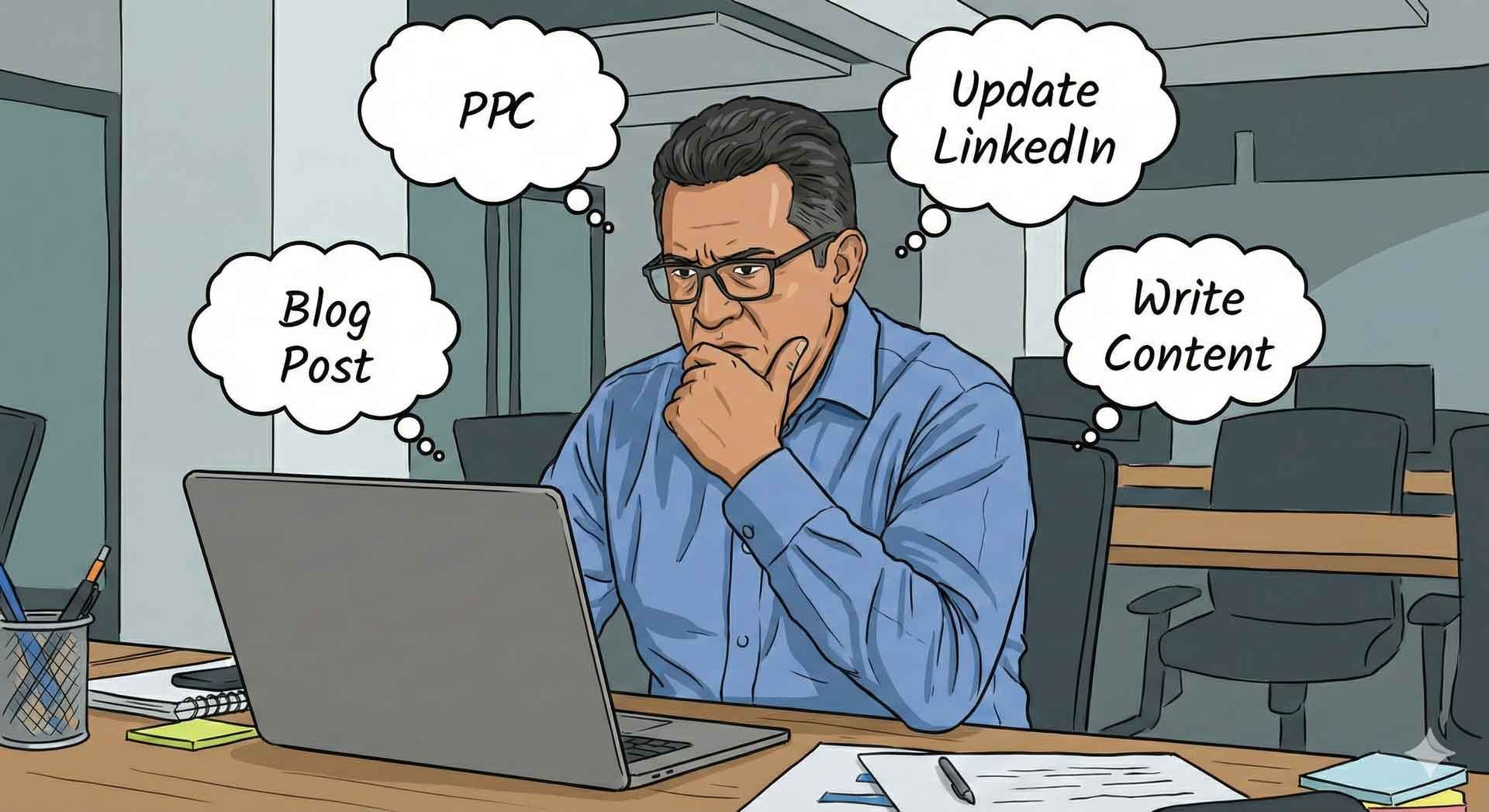
In my experience consulting with hundreds of business owners, I have noticed a recurring theme. There is often a significant amount of energy and money being poured into marketing, yet the results remain disappointing. We call this phenomenon "random acts of marketing." This random activity leads to wasted resources and disappointing results. This article explores why operating without a plan is a drain on your resources and how adopting a strategic framework gives structure and purpose to your digital marketing strategy.
The High Cost Of Random Marketing Activity
It is easy to fall into the trap of doing things just to feel productive. When sales slow down, the natural reaction is to increase activity. You might decide to boost a few posts on social media or sign a contract for a booth at a local trade show. While none of these actions are inherently wrong, doing them in isolation rarely moves the needle.
This approach creates a disjointed experience for your potential customers. If your trade show booth promises one thing, but your website says another, you are sending mixed signals. In the industrial and B2B sectors, where sales cycles are long and trust is paramount, confusion is a deal-killer.
Random activity burns through your budget because it lacks cumulative value. A single ad campaign that doesn't lead to a well-optimized website is a wasted opportunity. You need a solid base because building a skyscraper on sand is impossible if you don't start with the first, most critical component: a solid Foundation. To fix this, we need to stop thinking in terms of tasks and start thinking in terms of systems.
Defining A Marketing Framework
A marketing framework is simply an organized approach that gives structure and purpose to your strategy. Think of it like the blueprints for a commercial construction project. You would never order a crew to start pouring concrete or welding steel without a set of engineered plans. You need to know how the foundation supports the structure and how the electrical systems integrate with the mechanicals.
In marketing, a framework serves the same purpose. It ensures that effort and investment are placed on the things that matter most. It forces you to ask "why" before you ask "how."
For
B2B companies, a framework is essential because our buyers are rational and risk-averse. They need to be guided through a logical journey. A framework ensures you have built the necessary infrastructure to support them at every stage of that journey.
How Frameworks And Processes Work Together
It is important to understand that a marketing framework and detailed marketing processes are not competing solutions. In reality, they can be complementary forces that work together to drive success. While a framework provides the overarching strategy and sequential goals, process-driven marketing provides the discipline required to execute the work efficiently. The framework guides the services provided and the actions taken, while the processes ensure those actions are completed consistently. When you combine a clear strategic direction with rigorous execution, you create a powerful engine for business growth.
The Logic Of Sequential Growth
When I look at successful marketing strategies, they almost always follow a specific sequence. This is the logic behind the
FADA Marketing Framework that I use. It recognizes that you cannot successfully ask for a sale if you haven't first established who you are and reached the right audience. The framework's basic principles are sequential: building a solid Foundation, creating Awareness, establishing Differentiation, and inspiring Action.
When you skip steps, the system breaks. For example, if you spend heavily on advertising to build Awareness but your website Foundation is outdated and unclear, you are paying to send traffic to a dead end. If you have a great website and plenty of traffic but look exactly like your competitors due to a lack of Differentiation, you are likely losing deals on price.
A framework provides a diagnostic tool. Instead of guessing why sales are down, you can look at the sequence. Is the Foundation solid? Is the Awareness campaign reaching the right job titles? Is the Differentiation compelling? This structured approach removes the emotion and guesswork from the equation.
Common Signs You Are Committing Random Acts Of Marketing
- You focus on vanity metrics: You see plenty of activity but the needle on sales conversions barely moves.
- You skip the Foundation: You try to build a skyscraper on sand without starting with the most critical component.
- You lack Differentiation: You fail to answer the key question for customers regarding why they should choose you over everyone else.
- Your messaging is inconsistent: Inconsistencies can create confusion and erode trust.
- You have no clear path to Action: You miss the component that focuses on inspiring customers to engage and enter the sales pipeline.
Why Structure Matters For Search Engines And AI
Adopting a framework isn't just about human psychology; it is also critical for your digital visibility. Search engines like Google and new AI-powered search tools favor websites that demonstrate authority and structure.
When you produce content randomly, it is difficult for search engines to understand your area of expertise. However, when you follow a strategic plan, you naturally build a library of interconnected content. This is essential because generative AI focuses on positioning content as a trusted, authoritative source.
This cohesive structure signals to search engines that you are a subject matter expert. It helps you build topical authority, which relies on semantic depth. In the age of AI search or GEO, where machines are synthesizing answers from multiple sources, being recognized as a trusted authority is the only way to ensure your business is cited and recommended. A random approach simply cannot build this level of digital credibility.
Playing The Long Game In Houston
The
industrial and business marketing landscape here in Houston is incredibly competitive. Whether you are in oil and gas, logistics, or professional services, there are likely dozens of other companies vying for the same contracts. In Houston's crowded industrial market, competing on price is a race to the bottom. The businesses that win are rarely the ones that shout the loudest for a week and then disappear. The winners are the ones who show up consistently, with a clear message, over a long period of time.
A marketing framework is what allows you to play that long game. It provides a clear plan that gives purpose to marketing services. It allows you to measure progress and make small, iterative improvements that compound over time.
By moving away from random acts of marketing and embracing a strategic framework, you gain control over your growth. You stop hoping for results and start engineering them. It is a shift in mindset that requires discipline, but for the B2B business owner looking to build a legacy, it is the only path forward.