Turning Technical Code Into A Digital Handshake For Industrial Buyers
Trust drives industrial transactions. While we focus on handshakes, we often neglect building that same trust with search engines. This article explores Schema markup not as code, but as a translation layer that tells Google and AI tools exactly who you are. You will learn how this data structure establishes authority, boosts local Houston visibility, and how to use free tools to reverse engineer competitors and capture valuable rich results.
The Blueprint Your Website Is Missing
I like to think of Schema markup as the structural blueprint for your website's data. Without this blueprint, a builder, in this case a search engine, might have a general idea of the building, but they won't know the specific wiring, plumbing, or room dimensions. They are left guessing at the details.
With a blueprint, the builder has exact instructions for every component, ensuring everything is put in the correct place and functions optimally. When you apply this to your digital presence, it means your website's information is understood by search engines accurately and efficiently. This precision improves overall performance and user experience because Google no longer has to infer what you do; it knows for a fact.
This is where
Schema provides a competitive advantage. It is a standardized vocabulary of code that acts as that set of blueprints. It allows me to explicitly tell a search engine that a specific string of text is not just words, but a "Service," a "Product," or a "LocalBusiness" with a specific service area in Houston. By removing ambiguity, we build a direct line of communication with the algorithms that decide where and when to show your business to potential clients.
Why Accuracy Is The New Currency In Houston
In our local market, reputation is everything. You spend years earning certifications like ISO 9001 or API specs to prove to your human clients that you adhere to strict standards. Schema is essentially the digital equivalent of those certifications for search engines.
When you implement Schema correctly, you are feeding facts directly to the search engine. You are providing the "fuel" for Answer Engine Optimization (AEO). When a procurement manager asks a complex question, the search engine looks for verified facts to construct an answer.
If your website relies solely on standard text, the search engine has to guess or infer the details. If your competitor uses Schema to explicitly define their safety record, their years in business, and their exact service capabilities, the search engine has a higher degree of confidence in that data. In the eyes of an algorithm, confidence equals trust. And just like in the real world, the machine is more likely to recommend the vendor it trusts.
Essential Schema Types For Industrial Companies
For B2B and industrial business owners, the goal is not to mark up every single word on the website. The strategy should be to focus on the elements that establish your commercial capability and local presence.
Here are the specific types I recommend focusing on:
- Organization: This establishes your corporate identity, linking your logo, social profiles, and contact data to your brand entity.
- LocalBusiness: This is critical for Houston companies. It defines your physical location, hours, and crucially, your service area radius.
- Product: If you manufacture parts, this allows you to detail technical specifications, SKUs, and material types directly in the search results.
- Service: This is vital for contractors. It helps distinguish between broad categories like "construction" and specific niches like "heavy civil construction".
- Person: This builds authority by linking the bio of your subject matter experts to their content, reinforcing the "Experience" component of E-E-A-T.
Reverse Engineer Your Competitors' Strategy
If you are unsure where to start or which Schema types are most valuable for your specific niche, you don't have to guess. You can look at what is already working. One of the most effective strategies I advise clients to use is to reverse engineer the competitors who are currently beating them in search results.
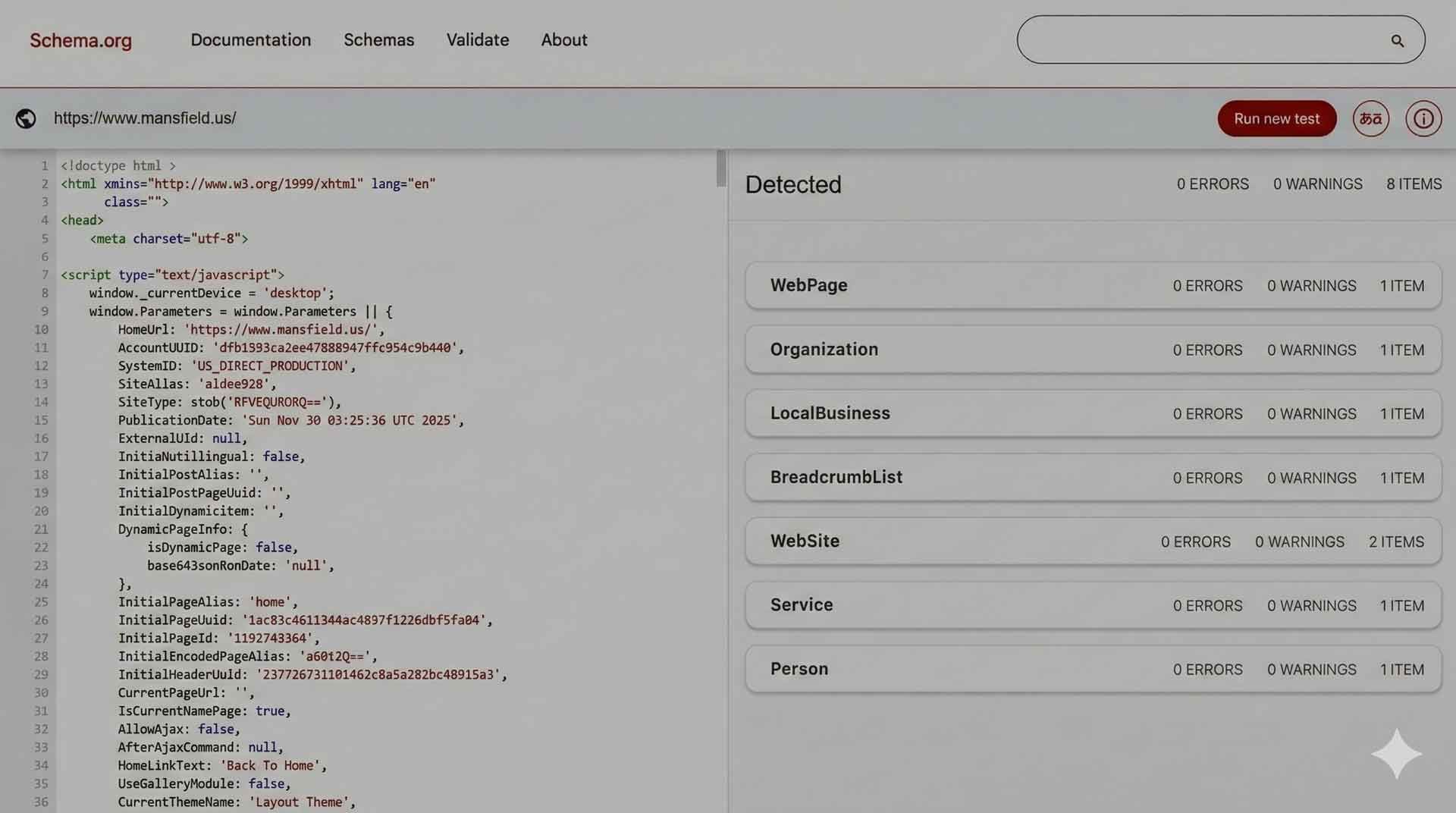
You can use the free
Schema.org Validator tool to peek under the hood of any website. Simply take the URL of a competitor who is ranking well in organic search or appearing frequently in AI overviews, and plug it into the validator. This will show you exactly what Schema markup they are using to communicate with Google.
However, raw code only tells half the story. I also highly recommend using
Google's Rich Results Test. This tool is invaluable because it shows you exactly how you, and your competitors, are taking advantage of specific schema types that enhance organic business listings. It identifies which markup is eligible to generate visual "rich results" on the search page, such as review stars or product pricing. By running a competitor's URL through this test, you can see precisely which visual enhancements they are winning, giving you a clear target for your own optimization efforts.
This isn't about copying their work. It is about understanding the standard they have set so you can
emulate and improve upon it. Use their success as a baseline, then build a better, more detailed map for the search engines to follow.
Preparing Your Business For The Era Of AI Answers
We are currently witnessing a shift in how industrial buyers find suppliers. They are moving from typing simple keywords into a search bar to asking complex, conversational questions to AI tools like ChatGPT or Google’s Gemini. This is the realm of Generative Engine Optimization (GEO).
These AI models are voracious consumers of structured data. They look for connections between entities. They want to know that "Company A" offers "Service B" in "Location C." Schema markup creates these connections in a way that is easy for the AI to ingest and synthesize.
When you provide this structured data, you are essentially training the AI on how to talk about your business. You are increasing the likelihood that when the AI constructs a narrative answer for a user, your company is cited as a verified source or a recommended solution. Without Schema, you are leaving it up to the AI to scrape and interpret your content, which can lead to hallucinations or, worse, being ignored entirely in favor of a competitor who provided clearer data.
Taking The First Step Without Getting Tangled In Code
I realize that for many business owners, the idea of adding code to a website sounds daunting. The good news is that you do not need to be a computer programmer to benefit from this strategy. The logic behind the strategy is what matters most.
The first step is simply to audit where you stand. Using the validators mentioned above, check your own site. You might be surprised to find that your current website platform is already doing some of this work for you, or you might find that you are completely invisible in this regard.
Once you know where you stand, the fix is often a matter of using the right plugins or consulting with your web management partner to ensure the fields are filled out correctly. The objective is to ensure that your digital foundation is as solid as your physical operation. By translating your real-world authority into a language that search engines understand, you ensure that your expertise is recognized, indexed, and delivered to the prospects who need it most.