

Originally Published in BIC Magazine, February 2019
BIC Magazine: Industrial Digital Marketing Strategies Really Work
Why B2B industrial companies need specialized digital marketing approaches that differ from consumer product strategies.

By Doug Mansfield | President, Mansfield Marketing

BIC Magazine Cover, February 2019
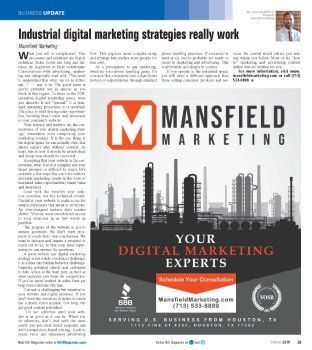
BIC Magazine Article, February 2019
February 2026 Update
The core argument in this article holds. Your website is still the cornerstone of your industrial marketing strategy. What has changed is where that cornerstone must perform.
In 2019, "performs well" meant ranking in Google search results. That measurement still matters, but it no longer tells the complete story. A significant portion of buyer research now happens inside AI platforms. When a procurement manager asks Gemini or Perplexity which industrial marketing agencies specialize in Houston-based manufacturing clients, the answer doesn't come from a ranked list of links. It comes from content those systems have indexed and synthesized into a direct response.
The website is still where that content lives. But the website must now communicate clearly to two audiences: the human visitor who eventually lands there, and the AI system that reads and interprets the site before any human arrives.
The "lead with benefits, not technical details" principle applies here in a way that wasn't obvious in 2019. AI systems extract meaning from content that is clearly written. Keyword-dense, technically cluttered pages that were marginally readable by humans are even harder for AI to interpret and cite with confidence. The companies getting cited as authoritative sources are the ones that communicate specific value propositions simply and directly.
The advertising prerequisite still stands. Don't run campaigns to a website that doesn't convert. That advice is now extended: don't invest in AI search optimization if your website content is vague, generic, or fails to communicate what makes you different from 50 other industrial companies. AI systems synthesize what you give them. If your content says "quality service and experienced team," that's what they'll work with.
One new prerequisite has emerged. The article mentioned phone handling as a prerequisite to advertising. I'd add a third prerequisite now: your cross-platform consistency. Your website, LinkedIn profile, trade publication presence, and any other crawlable content should all tell the same story with the same specifics. AI systems build their understanding of your company from all of these sources combined. Inconsistency across platforms creates a muddled representation. Consistency creates authority.
The industrial sector was slow to adopt digital marketing in 2019. That pattern is repeating with AI search. The companies building that foundation now will hold the same advantage in AI-generated results that early digital adopters held in organic search rankings.
The original article appears below.
Your Website is the Cornerstone of Industrial Marketing
What you sell is complicated. Your processes and solutions are highly technical. Sales cycles are long and initiated by engineers or field technicians. Conversations with advertising, marketing and salespeople start with, "You need to understand that what we do is different..." — and it is. The good news is you're probably not as special as you think in this regard. To those in the B2B/industrial digital marketing space, what you describe is not "special." It is standard operating procedure; it is assumed. The place to start driving sales opportunities, building brand value and awareness is your company's website.
Your domain and website are the cornerstones of your digital marketing strategy, sometimes even comprising your entire marketing strategy. It is the one thing in the digital space we can actually own, that others cannot alter without consent. At least, this is how it should be established, and exceptions should be corrected.
Lead with Benefits, Not Technical Details
Lead with the benefits your solution provides, not the technical details. Unclutter your website to make room for simple statements that speak to solutions. An over-designed website style creates clutter. Visitors want unrestricted access to your solutions in as few words as possible.
The purpose of the website is not to answer questions. We don't want prospects to reach their own conclusions. We want to intrigue and inspire a prospect to reach out to us, so that your sales representative can answer the questions.
Marketing as a Sales Challenge
A good website and digital marketing strategy is not solely a technical challenge; it is a sales and human behavior challenge. Inspiring potential clients and customers to take action is the hard part, as well as what separates you from the competition. If you've never worked in sales, then get help from someone who has.
Content is challenging but essential to your website and digital presence. If you don't have the resources or hours to create the content, that's normal. Get help, but get good content published.
Advertising and Phone Handling Strategy
Do not advertise until your website is as good as it can be. When you do advertise, don't lead with the most costly pay-per-click direct response ads with competition-based pricing. Look to brand value and awareness advertising first. This requires more complex setup and strategy but reaches more people for less cost.
As a prerequisite to any marketing, brush up your phone handling game. It's common that companies lose a significant portion of opportunities through standard phone handling practices. If voicemail is used at all, you're probably not ready to invest in marketing and advertising. This is affordable and simple to correct.
If you operate in the industrial space, you will need a different approach than those selling consumer products and services. Be careful which advice you take and whom you follow. Most of the "how to" marketing and advertising content online was not written for you.
This article was originally published in BIC Magazine (February 2019). Read the original publication →