

Originally Published in BIC Magazine, March 2020
BIC Magazine: First, You Need a Sales Plan
How lack of sales strategy defeats marketing plans. Essential sales processes including phone handling, CRM implementation, and lead tracking for industrial companies.

By Doug Mansfield | President, Mansfield Marketing

BIC Magazine Cover, March 2020
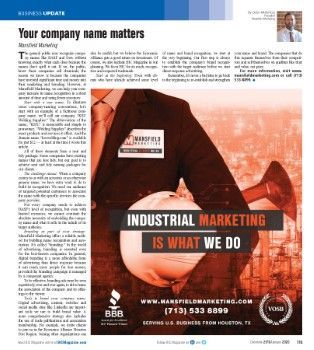
BIC Magazine Article, March 2020
February 2026 Update
Everything in this article still applies. Phone handling, CRM implementation, consistent messaging, trend tracking over perfect attribution. These fundamentals haven't changed. What has changed is the nature of some of the leads arriving through your sales process.
There's a new type of inquiry that didn't exist in 2020: the AI-referred prospect. When a buyer asks Gemini or Perplexity which commercial HVAC contractors specialize in healthcare facilities in Florida, and your company is cited in the answer, the person who contacts you has already done significant research. They know your credentials before speaking with you. They've read your content. They understand your positioning. The conversation starts differently than a cold web search click.
This changes the sales process in a specific way. The article's point about message consistency, "what you say should reflect what they see" - that principle becomes more important, not less. An AI-referred prospect has seen a synthesized version of your brand built from everything AI systems could find. If your sales conversation contradicts that representation, or if your website content hasn't kept up with how you actually position the company, the disconnect is visible immediately.
The article's recommendation to track leads by source and identify trends still applies. But AI-referred leads present a tracking challenge the article couldn't have anticipated. AI platforms often don't pass referrer data the way traditional web sources do. A prospect who found you through a Perplexity answer and then typed your URL directly into their browser shows up in analytics as direct traffic. This means the actual value of AI search visibility is likely underrepresented in standard attribution reports.
The practical adjustment is simple: ask. Make it standard practice during intake to ask how the prospect found you. Add that question to your contact form as an optional field. Over time, you'll start to see how many inquiries are coming from AI search channels that your analytics would otherwise misattribute.
The core premise of the article stands. Sales plan first, marketing investment second. The AI search update is this: your sales process needs to be ready to handle prospects who already know a lot about you before they've spoken to you. That's a different kind of ready than handling a cold prospect who found a generic ad.
The original article appears below.
Marketing Success Requires Sales Strategy
A lack of sales strategy can defeat your marketing plan. If your marketing goal is to obtain a positive return on your investment, you're probably going to judge the success or failure of your marketing plan by whether you make or lose money. Maybe you don't hold your marketing person, department or firm responsible for sales revenue, but when you are deciding whether to continue a marketing plan, sales should be a serious concern for your marketing staff regardless of whether they accept accountability for sales results. This is the common challenge we face as a marketing company.
Phone Call First Impressions
Over many years of service, we have identified several common "leaks" in sales processes. The most common leak we have found is poor phone-call handling. These mishandled calls can be identified using a phone tracking system that matches the marketing source of the calls and records the audio for training to improve handling.
If calls go to voicemail during business hours, that's the first problem to fix. Voicemail is a deal breaker for potential customers. A phone-answering service may not be ideal, but it's a good way to patch this leak, if necessary.
Motivate and Incentivize Your Team
Someone needs to be accountable for following up with prospective customers. Each team member who follows up should be motivated to convert sales leads into sales opportunities and sales opportunities into sales revenue. Incentives may or may not include commissions or bonuses, but being responsible for completing the sale is generally best accomplished by rewarding success instead of penalizing failure.
What You Say Needs to Reflect What They See
When speaking or communicating with potential customers, the message you deliver should be consistent with the information they gathered before reaching out to you. If the message on your website, brochures or pitch decks is different from what you say in conversation, fix that. Be consistent in describing the problems you solve and the benefits of your products or services.
Get a CRM and Use It Correctly
A customer relationship manager (CRM) tracks sales and helps measure the effectiveness of your sales program. Sales Force may be the best known, but it is not always the best solution. At Mansfield, we believe simplicity is the key to success when it comes to CRMs. This is especially true for small companies that may not have a dedicated sales team. Consider CRM alternatives like Sugar or Copper. Be sure to test the CRM before signing a contract to commit. There is a big difference between what each CRM offers.
Trends Over Perfect Tracking
"Analysis paralysis" is a real thing. A balance must be struck between perfectly measuring every minute detail and dedicating energy to doing. One strategy is to match every sales lead to a known marketing source. Trends are the most important metric. For example, if we can identify that approximately 50 percent of our sales leads come from our website, and 25 percent of those leads convert to revenue, we have the information we need to make an informed decision about the future investment of our marketing dollars.
Your sales plan is the foundation that enables marketing to generate measurable ROI. Without proper phone handling, follow-up systems, consistent messaging, and tracking mechanisms, even the best marketing campaigns will fail to convert opportunities into revenue.
This article was originally published in BIC Magazine (March 2020). Read the original publication →