

FADA® Framework • Step 03 of 4

Differentiation Is the Reason a Buyer Chooses You

Differentiation is Step 03 of the FADA® Framework and the heat in Mansfield's Fire Triangle. It is where a buyer who has found several capable vendors decides which one to actually contact. It is not quality, experience, or customer service. Those are table stakes every competitor claims. Differentiation is the specific, verifiable reason your operation is the right one, stated where the buyer is comparing.

Home > FADA Marketing Framework > Step 03: Differentiation

One of Four Elements That Work Together

FADA runs in sequence. This page covers the third element. The map below shows how it connects to the other three.

Differentiation only matters once buyers can find you and verify you. Foundation gives them something to evaluate and Awareness brings them to it. Differentiation is the heat that decides the outcome: the verifiable reason a buyer picks you over the other names on the same shortlist.

Differentiation Is the Heat, Not the Fuel

By the time Differentiation matters, the buyer has already found several vendors that can technically do the work. Foundation got them to a site that answers their questions. Awareness made sure they found it. Now they are comparing, and comparison is where most industrial companies quietly lose.

They lose because their messaging sounds like everyone else on the list. Quality. Experience. Customer service. On-time delivery. Every competitor says the same words, so the words decide nothing.

"Quality and service are not differentiators. They are the price of being considered at all."

Real differentiation is specific and verifiable. It is the machine list, the tolerance range, the certification that matches the buyer's evaluation criteria, the capacity figure, the in-house capability a competitor has to outsource. These are the things a buyer can check, and checkable claims are the only ones that move a decision. When the difference is clear, buyers self-qualify: the right ones recognize a fit and the wrong ones screen themselves out, so the inquiries that come in match the work the company actually wants.

Vague claims do the opposite. They force the buyer to compare on the one dimension that is always legible: price. A company that has not differentiated on capability has, by default, differentiated on nothing, and nothing competes on cost.

Differentiation Is the Heat of the Fire Triangle

A fire needs fuel, oxygen, and heat together. Fuel and oxygen can sit in the same room indefinitely and nothing happens. Heat is the energy that starts the reaction. In the FADA® Framework, Differentiation is that heat.

🔥 ACTION THE RESULT FOUNDATION FUEL | STEP 01 AWARENESS OXYGEN | STEP 02 DIFFERENTIATION HEAT | STEP 03 | YOU ARE HERE
🔥 Differentiation = Heat

Put fuel and oxygen together and you still do not have a fire. You have the conditions for one. Something has to ignite it. Heat is the deciding energy, the element that turns potential into a reaction.

That is Differentiation's job. Foundation (fuel) and Awareness (oxygen) get a qualified buyer to a presence that can convince them. But a buyer comparing several qualified vendors is fuel and oxygen sitting side by side, waiting. Differentiation is the spark that makes them choose. Without it, the buyer keeps looking, or defaults to price, and the reaction never starts.

Heat is also the element buyers feel most directly. A verifiable, specific advantage is what a procurement committee repeats to each other when they narrow the list. It is the sentence that survives the meeting after the buyer closes the browser. Get the heat right and the fire lights on its own.

Four Sources of a Verifiable Advantage

Differentiation is not a tagline. It is the deliberate surfacing of the concrete, checkable facts a buyer uses to separate one capable vendor from another. Each source below answers the buyer's real question: why you instead of the others.

Certifications That Match Criteria

The certifications and approvals tied directly to how the buyer evaluates suppliers, stated plainly where they compare vendors. A certification a competitor lacks, or one that maps exactly to a buyer's requirement, is a decision on its own. Buried in a PDF, it decides nothing.

Capacity & Operational Specifics

The concrete parameters that define what the operation can actually do: machine list, tolerance ranges, part sizes, throughput, materials, lead times. Specifics let a buyer confirm fit without a call, and confirmed fit is what turns comparison into contact.

Capabilities Others Outsource

The work done in-house that competitors have to send elsewhere. A single-source, one-roof capability removes handoffs, risk, and time from the buyer's project. Named clearly, it becomes the reason a buyer stops comparing and starts a conversation.

The Factors Buyers Actually Compare

The specific criteria a given buyer weighs when choosing, surfaced instead of buried. Differentiation means leading with what the buyer is actually deciding on, not with the generic virtues every vendor lists. Say the thing that ends the comparison in your favor.

What Sounding Like Everyone Looks Like, and What Standing Out Looks Like

Differentiation failures are the hardest to see from the inside, because the claims feel true. The company does have quality and experience. The problem is that saying so puts it in an undifferentiated pile with every competitor who says the same. These patterns recur across capable operations.

01 Precision Machining Shop
The Gap

The site leads with quality, experience, and on-time delivery, the same three claims as every competitor on the buyer's list. Nothing on the page tells the buyer why this shop over the others, so the decision drifts toward whoever quotes lowest.

The Differentiation Work

Replace the adjectives with verifiable specifics: the machine list, the tolerances held, the quality certification, the materials and part sizes. Lead the comparison with facts a competitor cannot copy by simply claiming them too.

Why It Works

The buyer now has a concrete reason to choose that survives a committee discussion. The shop competes on documented fit instead of price, and the inquiries that come in match the work it actually wants to win.

02 Industrial Coatings Provider
The Gap

The company runs anodizing and finishing in-house, a genuine advantage over competitors who subcontract it. But the site mentions it once, in passing, framed as one service among many rather than the reason to choose them.

The Differentiation Work

Lead with the single-source, one-roof capability and make the advantage explicit: machined, finished, and shipped without a handoff to a third party. State what that removes for the buyer in risk, time, and coordination.

Why It Works

The advantage becomes the headline instead of a footnote. Buyers who value single-source responsibility self-qualify and reach out specifically for it, and the company stops competing as a generic finisher.

03 Metal Fabricator
The Gap

Competing purely on price because nothing else in the messaging distinguishes the operation. The fabricator holds certifications and capacity that several competitors do not, but none of it is positioned as a reason to choose, so every deal comes down to the number.

The Differentiation Work

Surface the certifications and capacity that map to the buyer's evaluation criteria and that competitors cannot match. Position them as the qualifying difference, so the conversation starts on fit rather than on cost.

Why It Works

The fabricator gives buyers a basis to choose it beyond price. Deals that were pure cost comparisons become fit comparisons, which is a contest a stronger, better-credentialed operation can actually win.

What Happens Without Differentiation

Skip Differentiation and the company gets found, gets evaluated, and then loses to a vendor that gave the buyer a clearer reason to choose.

The cruelest version is the one where Foundation and Awareness worked perfectly. The company educated the buyer, answered every question, and made the shortlist. Then, with nothing specific to separate it from the other finalists, it watched the buyer take everything they learned and hand the contract to a competitor. Effective Foundation and Awareness without Differentiation can amount to educating buyers on behalf of the company that wins.

When nothing distinguishes the options, the decision defaults to price. That is a race the most capable operation rarely wants to win.

Found, Then Passed Over

✗ The Chain Reaction
  • 1. Foundation converts and Awareness brings the right buyer
  • 2. The company makes the shortlist of capable vendors
  • 3. Its messaging sounds like every other finalist
  • 4. The buyer finds no verifiable reason to prefer it
  • 5. The decision defaults to price, or to a clearer competitor
  • 6. The contract goes elsewhere, with the company's own education

What Differentiation Execution Actually Looks Like

Differentiation is not a clever tagline or a brand exercise. It is the disciplined work of finding what is genuinely, verifiably different about an operation and putting it where buyers compare.

Each step below trades an adjective for a fact. Facts are what a buyer can check, repeat, and defend to a committee. Adjectives are what every competitor already claims.

  • 01
    Trade Adjectives For Specifics

    Every generic claim (quality, experience, service) is replaced with a concrete, verifiable fact: a tolerance, a certification, a capacity figure, a materials list. If a competitor could copy the claim by simply writing the same word, it is not differentiation and it gets replaced.

  • 02
    Match Certifications To Buyer Criteria

    The certifications and approvals surfaced are the ones tied directly to how the buyer evaluates suppliers, positioned where they compare vendors rather than buried in a downloadable line card. A credential the buyer is specifically looking for is a decision, if they can see it.

  • 03
    State Capacity And Operational Specifics

    Machine lists, tolerance ranges, part sizes, throughput, and in-house capabilities are stated plainly, so a buyer can confirm fit without a call. The single-source or one-roof advantages that competitors have to outsource are named as advantages, not left implied.

  • 04
    Lead With What Buyers Actually Compare

    Messaging is built around the specific criteria a given buyer weighs, not the virtues every vendor lists. The advantage that ends the comparison in the company's favor goes first, where it does the most work, not last where no one reads it.

Further Reading

Differentiation in the Field

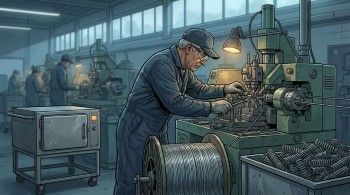
Setup technician tooling a CNC spring coiler on the production floor of a precision spring plant
By Doug Mansfield • September 22, 2026
Component makers win recurring volume by getting designed into the bill of materials. What design engineers verify before a part number goes on the print.

Floor care technician running a ride-on auto scrubber down a distribution center aisle at night
By Doug Mansfield • September 17, 2026
Facility and janitorial services get commoditized into low-bid contests when reliability and standards are not visible before the bid. Here is what holds price.

Hydraulic technician seating a new rod seal stack on a rechromed cylinder rod in a rebuild bay
By Doug Mansfield • September 3, 2026
Hydraulic and fluid power specialists lose search visibility to national distributors because their sites list categories instead of stating repair capability.

Hydraulic press forging a glowing steel billet in a closed die as the operator runs the controls
By Doug Mansfield • August 27, 2026
Forging and die casting buyers who see only price will award only on price. How to make metallurgy, process control, and defect rates visible before the quote.

Building engineer calibrating a differential pressure sensor on a rooftop chilled water pump
By Doug Mansfield • August 25, 2026
Owners and asset managers grade property services providers on retention and occupancy outcomes. Marketing that leads on price undersells the real value.

Turnaround crew hoisting a new ultra-low NOx burner into a refinery process heater firing deck
By Doug Mansfield • August 18, 2026
Buyers of combustion and power equipment decide on uptime, emissions compliance, and total cost of ownership. Here is how to reframe messaging around that.

NDT technician performing wet fluorescent magnetic particle testing on a forged steel crankshaft
By Doug Mansfield • August 4, 2026
The highest-value position for a testing or NDT lab is being named inside a customer's quality requirement, not competing per job. Here is how a lab earns it.

Field service technician performing on-site repair on a hydraulic excavator engine bay
By Doug Mansfield • July 21, 2026
Heavy equipment buyers choose dealers on uptime, service response, and downtime cost, not fleet size. Here is how dealers should reposition their marketing.

Precision machining facility floor with CNC machines running and operators moving between stations
By Doug Mansfield • June 16, 2026
Industrial B2B buyers evaluate industry expertise before submitting an RFQ. Learn why leading with sector knowledge wins better inquiries and shorter sales cycles.

Show More

Step 04: Action

Differentiation gives the buyer a reason to choose. Action is what happens next: the qualified inquiry, the RFQ, the contract, made possible by an engagement path with the friction removed. It is the fire the first three elements light.

Explore Action →