
Originally Published in BIC Magazine, June/July 2019
BIC Magazine: Branded SEO is Priority No. 1 in the Industrial Sector
Why industrial companies should prioritize branded SEO over keyword-driven SEO to control brand messaging and compete on trust rather than price.

By Doug Mansfield | President, Mansfield Marketing

BIC Magazine Cover, June/July 2019
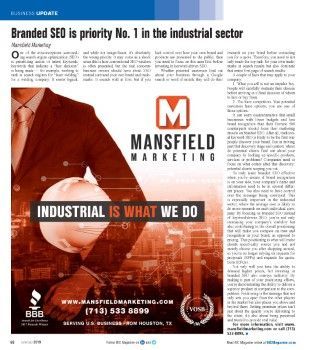
BIC Magazine Article, June/July 2019
February 2026 Update
When I wrote this article in 2019, the entire premise centered on Google. Branded SEO meant owning the search results page for your company name. Control what Google shows when someone searches for you, and you control first impressions. That argument remains valid.
What I didn't account for was AI search changing what "owning your brand" actually means.
A growing share of industrial B2B research now starts with an AI system rather than a search engine. Facility managers, procurement managers, and engineers are asking Google AI Overviews, Perplexity, and Gemini questions like "who are the best commercial HVAC contractors in Tampa?" or "what should I look for in a contract manufacturer?" The answers come back as synthesized recommendations, not a list of links.
Your brand shows up in those answers, or it doesn't.
The original article argued that branded SEO builds trust by ensuring consistent representation of your company across search results. That principle has expanded significantly. AI systems synthesize your brand identity from every crawlable source they can find: your website, your LinkedIn company page, your founder's LinkedIn profile, trade publication articles, and any other indexed presence. If those sources tell inconsistent stories about what you do and who you serve, the AI builds an inconsistent picture of your company.
The companies winning in AI search right now treated every indexed platform as a branded SEO asset early. Not just their website.
The other shift worth noting is that branded SEO has become the prerequisite for AI authority, not just a foundation before keyword-driven SEO. In 2019 I framed this as something to establish before investing in keyword campaigns. Now I frame it as the foundation before AI discoverability. If an AI system can't confidently identify what your company does, who it serves, and why it's credible, it won't cite you in responses where you'd otherwise qualify.
The core argument from 2019 holds. Industrial companies compete on trust rather than price, and branded SEO is how you establish that trust at scale. The platform mix for building that trust has simply expanded beyond what anyone was thinking about five years ago.
The original article appears below.
The Misconception About SEO Priorities
One of the misconceptions surrounding search engine optimization (SEO) is prioritizing action or intent keywords, keywords that indicate a "buy decision" is being made — for example, working to rank in search engines for "laser welding" for a welding company. It seems logical, and while not insignificant, it's absolutely the wrong priority. It may come as a shock since this is how conventional SEO wisdom is often presented, but the real concerns business owners should have about SEO instead surround your own brand and trademarks. It sounds wild at first, but if you lack control over how your own brand and products are presented to the public, then you need to focus on this area first before investing in keyword-driven SEO.
Whether potential customers find out about your business through a Google search or word of mouth, they will do their research on your brand before contacting you for a quote. Therefore, you need to not only reach the top rank for your own trademarks in search results but also dominate that entire first page of search results.
The Challenge Ahead
A couple of facts that may apply to your company: (1) What you sell is not an impulse buy. People will carefully evaluate their choices before arriving at a final decision of whom to hire or buy from. (2) You have competitors. Your potential customers have options; you are one of those options.
It can seem counterintuitive that small businesses with lower budgets and less brand recognition than their Fortune 500 counterparts should focus their marketing muscle on branded SEO. After all, traditional keyword SEO is likely to be the first way people discover your brand. But in moving past that discovery stage and context, where do potential clients find out about your company by looking up specific products, services or problems? Companies need to focus on what comes after that discovery: potential clients scoping you out.
Branding as Part of Your Strategy
To truly make branded SEO effective when you're unsure if brand recognition is on your side, your company's name and information need to be in several different places. You also need to have control over the message being conveyed. This is especially important in the industrial sector, where the average user is likely to do more research on each individual company. By focusing on branded SEO instead of keyword-driven SEO, you're not only increasing your company's visibility but also contributing to the overall positioning that will make you compete on trust and recognition in your brand, as opposed to pricing. That positioning is what will make clients specifically source you and not merely choose you after shopping around, so you're no longer relying on requests for proposals (RFPs) and requests for quotations (RFQs).
Not only will you have the ability to demand higher prices, but investing in branded SEO also conveys authority. By making it part of your positioning efforts, you're demonstrating the ability to deliver a superior product in comparison to the competition. Positioning is the message that not only sets you apart from the other players in the market but also places you above and beyond them. Setting premium prices isn't just about the quality you're delivering to the client; it's also about being perceived and trusted to provide real value.
For industrial companies, branded SEO is the foundation that enables all other marketing efforts to succeed. Start at the beginning to establish and strengthen your name and brand. The companies that do this separate themselves from their competitors and sell themselves on qualities like trust and value, not price.
This article was originally published in BIC Magazine (June/July 2019). Read the original publication →