

Originally Published in BIC Magazine, August 2020
BIC Magazine: You're Asking the Wrong Marketing Questions
How lack of sales strategy defeats marketing plans. Essential sales processes including phone handling, CRM implementation, and lead tracking for industrial companies.

By Doug Mansfield | President, Mansfield Marketing

BIC Magazine Cover, August 2020
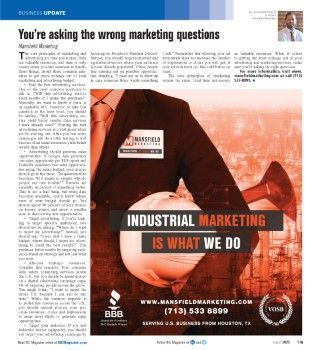
BIC Magazine Article, August 2020
February 2026 Update
The framework in this article, asking better questions rather than defaulting to obvious ones, applies directly to how industrial companies should be thinking about AI search in 2026.
The article argues that "will this advertising service yield results" is the wrong question. The right question is comparative: "will this yield better results than what I'm already doing?" That same logic applies now.
The wrong question is "how do I improve my Google rankings?" Not because rankings don't matter, but because it's an incomplete question in 2026. A meaningful portion of B2B industrial buyer research is happening inside AI platforms before anyone reaches a ranked search result. The right question is: "when a buyer asks an AI system for help finding a company like mine, what answer does it give, and is my company in that answer?"
That question leads to a different set of actions than traditional SEO. It's less about technical optimization of individual pages and more about building cross-platform authority that AI systems can synthesize into confident recommendations. Trade publication presence, consistent LinkedIn activity, specific and differentiated website content, and indexed long-form articles all contribute. These are measurable, but the measurement looks different from click-through rates and ranking positions.
The 80/20 principle the article describes, spend the majority of budget on known returns, invest a smaller portion discovering new opportunities, applies to AI search. The challenge is that AI search returns aren't yet visible in standard analytics. AI-referred traffic often arrives without referrer attribution, making it easy to underestimate. The answer isn't to ignore the channel until measurement improves. It's to invest now while competition in AI-cited positions is still relatively low.
The geographic targeting argument is still valid. The article uses national reach as an example of inefficient resource allocation. The same logic applies to AI search targeting. A company that serves the Gulf Coast industrial corridor doesn't need to compete for AI citations in Minneapolis. Specific geographic and industry positioning in your content makes it easier for AI systems to match your company to relevant buyer queries and easier for buyers to self-qualify before contacting you.
The core principle holds: the quality of your questions determines the quality of your marketing strategy. The new questions worth asking center on AI search visibility, cross-platform consistency, and how buyers are researching before they ever contact you.
The original article appears below.
Time and Money: Your Most Valuable Resources
The core principles of marketing and advertising are time and money. Both are valuable resources, and time is truly money when you hire someone to handle these things. Avoid these common mistakes to get more mileage out of your marketing and advertising budget.
Find the Best Advertising Services
One of the most common questions to ask is, "Will this advertising service yield results if I make the purchase?" Naturally, we want to know if there is an equitable ROI. However, to take this question to the next level, you should be asking, "Will this advertising service yield better results than services I have already used?" Finding the best advertising services is a best guess when you're starting out. After you run some campaigns and do a little testing, it will become clear some resources yield better results than others.
Advertising Should Generate Sales Opportunities
If Google Ads generates one sales opportunity per $100 spent and LinkedIn generates two sales opportunities using the same budget, your money should go to the latter. The question then becomes, "If it seems so simple, why do people run into trouble?" Humans are naturally in pursuit of something better. This is not a bad thing, but when data becomes available, you'll know where most of your budget should go. You should spend 80 percent of your money on known returns and invest a smaller sum on discovering new opportunities.
Target Advertising Strategically
If you're looking to target specific audiences, you should not be asking, "Where do I want to target my advertising?" Instead, you should ask, "Given that I have a finite budget, where should I target my advertising to yield the best results?" This produces better results by targeting audiences based on strategy and not just what you want.
Allocate Strategic Resources
Consider this scenario: Your company sells safety consulting services across the U.S., but you decide to spend money on a digital advertising campaign capable of targeting people across the globe. You might think, "I want to target the entire U.S. because I can sell to any state." While the common impulse is to proliferate resources across the U.S., you should instead allocate your precious resources, clicks and impressions to areas most likely to generate sales opportunities.
Target Your Audience Precisely
If you sell industrial tractor equipment, you should not target your advertising campaign by focusing on Houston's Museum District. Instead, you should target industrial and agricultural sectors where your audience is most densely populated. Often, people fear missing out on possible opportunities, thinking, "I need my ad to show up in case someone there wants something I sell." Remember that showing your ad nationwide does not increase the number of impressions or clicks you will get; it only spreads them out like cold butter on toast.
The core principles of marketing remain the same: Treat time and money as valuable resources. When it comes to getting the most mileage out of your advertising and marketing services, make sure you're asking the right questions.
This article was originally published in BIC Magazine (August 2020). Read the original publication →