The Digital Transformation of the Industrial Sector
If you run an industrial business in Houston, you know we live in a unique bubble. The scale of industry is staggering, and for decades, business could be won or lost on a handshake, a long-standing relationship, or a reputation built over years.But I see the ground shifting, and many owners are feeling it, too. What worked for 30 years is suddenly feeling less effective. The "good old boys" network is being replaced by procurement departments, digital-native purchasing agents, and a global marketplace that lives right here in our backyard.
Defining the Industrial Marketing Niche
As a marketing strategist based right here in the Houston area, I, Doug Mansfield, have spent my career navigating this exact intersection of old-school industry and new-school digital strategy. Industrial marketing is a specific subset of B2B, but even that's too broad. The challenges for a machine shop in Conroe are vastly different from a logistics company at the Port.
Houston: The Opportunity and The Competition
There's a reason Houston is a global industrial hotspot. We have the Port, the energy corridor, a massive manufacturing base, and the logistics infrastructure to connect them all. This concentration creates incredible demand and opportunity.
But that same opportunity is a magnet for your competition. And it's not just the company across the street anymore. It's a national firm opening a local branch, or a global competitor who can ship here just as easily as you can. This intense competition is why "just being good at what you do" is no longer enough.
The Many Faces of Houston Industrial Marketing
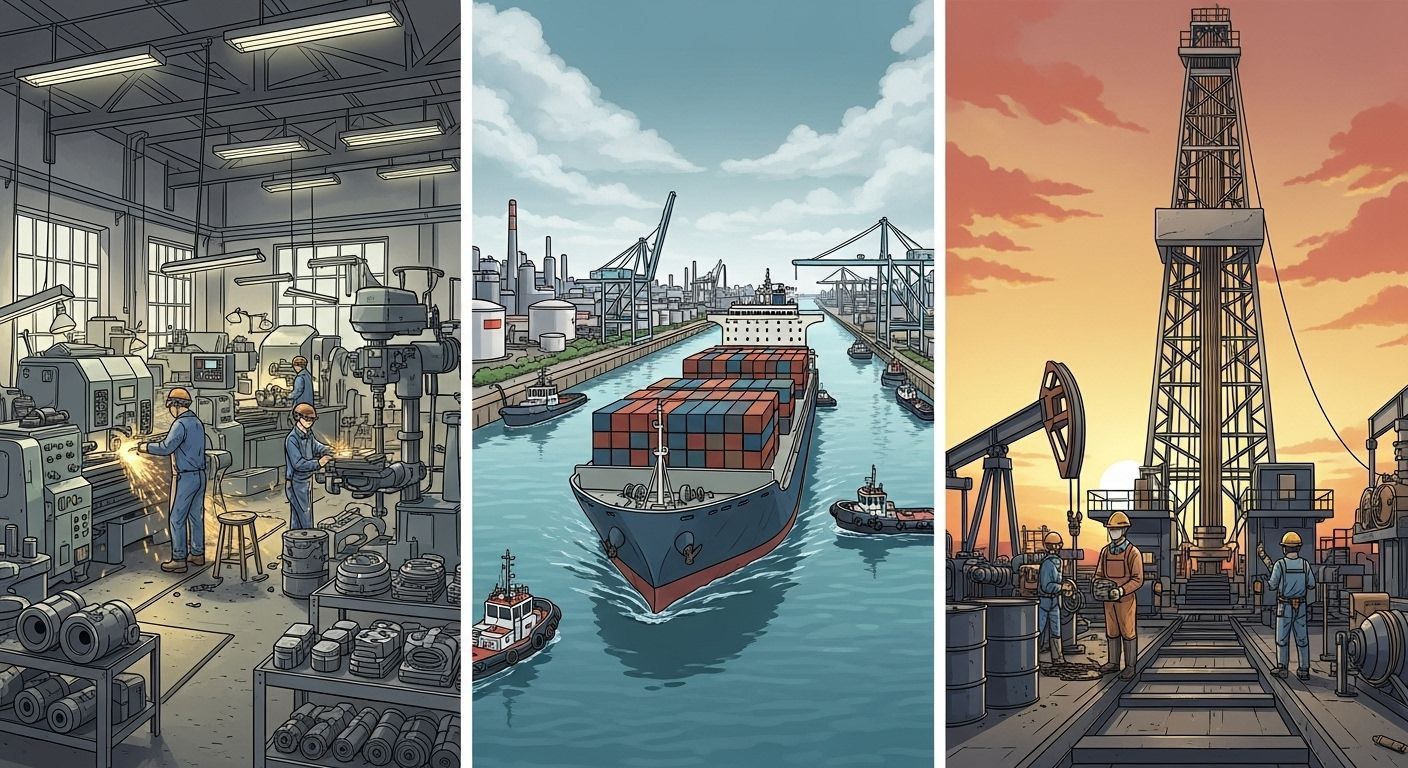
To win, you have to understand the specific game you're playing. Here are just a few of the industrial subsets I see in Houston and the unique challenges they face:
- Energy (O&G and Renewables):
- Challenge: Long, complex sales cycles and volatile market demand. You're selling high-stakes, high-capital solutions, and "trust" is the most important commodity.
- Opportunity: The energy transition is creating entirely new markets. Demonstrating your expertise (your
Differentiation ) in new technologies or efficiencies can set you apart for the next 20 years.
- Heavy Manufacturing & Fabrication:
- Challenge: You're often competing with low-cost global producers. Purchasing agents commoditize your service, focusing only on price and lead time.
- Opportunity: Showcasing your quality, precision, and certifications (like ISO 9001) is key. Your digital presence is the only way to prove you're a high-quality specialist, not a commodity "job shop."
- Logistics & Maritime:
- Challenge: It's an industry of massive scale but often razor-thin margins. You're competing on price and efficiency in a hyper-congested market.
- Opportunity: Technology and service are your differentiators. Can you use marketing to highlight your advanced tracking, your reliability, or your specific expertise in drayage from the Port of Houston?
- Industrial Services (Maintenance, Testing, Rentals):
- Challenge: Your service is often "invisible" until something breaks. You're a line item, and the constant battle is proving your value to prevent downtime.
- Opportunity: Your marketing is your sales team. You can build
Awareness by educating clients on preventative maintenance, positioning your service as an investment, not an expense.
The Shift from Handshakes to Handsets
It's still true that relationships matter. But how those relationships begin has changed forever.
More and more, purchasing agents, engineers, and project managers are performing their due diligence online before they ever make a call. They are tasked with justifying their decisions, which means they need to find, compare, and vet suppliers on their own time.
This leads to a painful reality I discuss with many owners:
You will never know the opportunities you missed, not because your digital presence was bad, but because someone else's was better.
When that purchasing agent searched online, they found your competitor first. They found their case studies, their certifications, their professional-looking website. They were vetted and shortlisted before you even knew an opportunity existed.
Your Foundation: The Website and LinkedIn
This is why, in my
FADA® marketing framework , we start with
Foundation . Your digital foundation is the bedrock of your brand, and it consists of two key assets for Houston industrial companies.
- Your Website: This is your digital headquarters. It's not just a brochure; it's your single most important salesperson. It must be clear, professional, and built to prove you solve your customer's problems. A weak website undermines every other dollar you spend on marketing.
- LinkedIn: This is, without a doubt, the network of choice for industrial B2B. But how you use it matters. You have a strategic choice to make:
- Investing in your LinkedIn Company Page:
- Pros: This is your official brand hub. It's permanent, professional, can run paid ads, and showcases all your employees.
- Cons: Organic reach is very low. It feels "corporate" and is not effective for building personal trust.
- Investing in your Personal Profile (and those of your leaders):
- Pros: Organic reach is significantly higher. It builds personal trust (people buy from people). It's a direct tool for networking and starting conversations.
- Cons: It's tied to an individual. If that person leaves, their network and influence go with them.
My recommendation? You need both. Your Company Page acts as the solid
Foundation . Your leaders' Personal Profiles are your
Awareness engine, used to build relationships and share expertise.
The New Search: SEO vs. GEO (and the Rise of AI)
For years, we all focused on
SEO (Search Engine Optimization). This is the science of getting your website to rank on Google for specific keywords, like "industrial fabrication Houston." It's about answering a direct query.
Now, we must also focus on GEO (Generative Engine Optimization). This is entirely different. It’s the practice of creating content that is so clear, authoritative, and well-structured that Generative AI engines (like ChatGPT, Perplexity, and Google's AI results) will use it as source material for their answers.
This shift is critical because GEO is increasingly becoming the starting point of purchase decisions. More and more, your potential customers are asking complex, conversational questions to AI assistants before they even go to Google.
If you are not discovered at the headwaters of this purchasing search process, you stand a much lower chance of making it downstream to winning new business.
Think about the difference.
- SEO Query: "pump repair Pasadena"
- GEO Prompt: "Repair vs. retrofit 10-year-old X-brand pumps: Compare long-term costs vs. downtime risks and list Houston-area service providers with published case studies."
How do you get found by that AI? You won't win with simple keywords. You will only win by having deep, specific, expert-level content on your website that directly answers complex questions. The AI is looking for authority, not just a location.
You must create content that proves you are the expert:
- A fabricator needs a detailed article: "Choosing the Right Weld Procedure for API-650 Tank Repair in High-Corrosion Petrochemical Environments."
- A logistics company needs a whitepaper: "A Comparative Analysis: Drayage Efficiency vs. Cost for Oversized Cargo from the Port of Houston."
- An engineering firm needs a technical guide: "The Top 5 Material Failures in Gulf of Mexico Subsea Components (And How to Engineer Against Them)."
This is the content that AI engines will find, trust, and use to recommend you as the solution. This content simultaneously builds your
Foundation, creates Awareness, and proves your
Differentiation—all leading to Action .
Let's Tackle This Challenge Together
I'm Doug Mansfield, and my firm, Mansfield Marketing, is built to solve these exact problems. I understand the unique challenges of industrial marketing in Houston because I'm part of this community.
We don't just build websites or "do SEO." We apply the FADA framework to build a comprehensive marketing strategy that respects the importance of old-school reputation while aggressively capturing new-school digital opportunities. We help you get found by the right people, prove your expertise, and make sure you're never invisible when a new opportunity arises.