What OEM Buyers Actually Need to Qualify a Manufacturer
Production qualification is not a marketing exercise. When an OEM buyer lands on a contract manufacturer's website, they are not browsing. They are screening. The question they arrive with is not "what do you do?" It is "can you handle our program?" That is a capacity question, not a capability question, and the two are not the same thing.
What I see on many contract manufacturer websites is a capability narrative. Materials processed, tolerances held, certifications earned. Good information, but incomplete. The buyer who needs 8,000 parts per quarter on a blanket PO needs to know your shop can absorb that program without disrupting their current delivery schedule. That requires production data, not process descriptions.
I've written before about
why contract manufacturers attract prototype RFQs instead of production orders. The short version: the website signals prototype shop, even when the floor runs full production shifts. Fixing that starts with what the site communicates about capacity.
Why Capacity-Specific Positioning Wins Production Contracts
OEMs sourcing contract manufacturers are managing supply chain risk, not just cost. A buyer who awards a production program to the wrong partner faces line stoppages, quality escapes, and the political problem of having to explain the switch to their engineering and procurement leadership. So they qualify conservatively. They look for signals that you have done this before at scale.
Capacity-specific positioning answers the risk question before it becomes a disqualifier. A manufacturer that states dedicated production lines, annual output by part category, and typical run sizes communicates something that generic capability language never can: predictability. That is what production buyers are actually paying for.
The manufacturers
getting in front of OEM buyers are the ones who understand this distinction. They present their operation in terms that map to an OEM's qualification checklist, not their own shop culture.
Three Numbers That Move Buyers from Interest to Inquiry
Annual capacity, production lead times, and minimum order quantities. If these three numbers are not visible on a manufacturing website, the buyer has to ask. And asking introduces friction at exactly the wrong moment in the evaluation process.
Annual capacity by part type or machine classification tells an OEM whether a shop can absorb their program volume without capacity constraints becoming a recurring problem. Lead time for production runs signals operational maturity. A shop that knows its lead times knows its floor. Minimum order quantities establish program fit early, which saves time for both parties.
Burying this information or omitting it entirely is one of the more common patterns I see on
precision machining websites. The shop that presents these numbers prominently filters out mismatched inquiries and gives qualified buyers what they need to move forward.
The Operational Transparency That Builds Buyer Confidence
Shift structure is an underused signal in manufacturing marketing. A two-shift or three-shift operation tells a production buyer things that no marketing language can convey as efficiently: that the shop runs volume, that management has built systems to handle it, and that capacity exists beyond a single-crew workday.
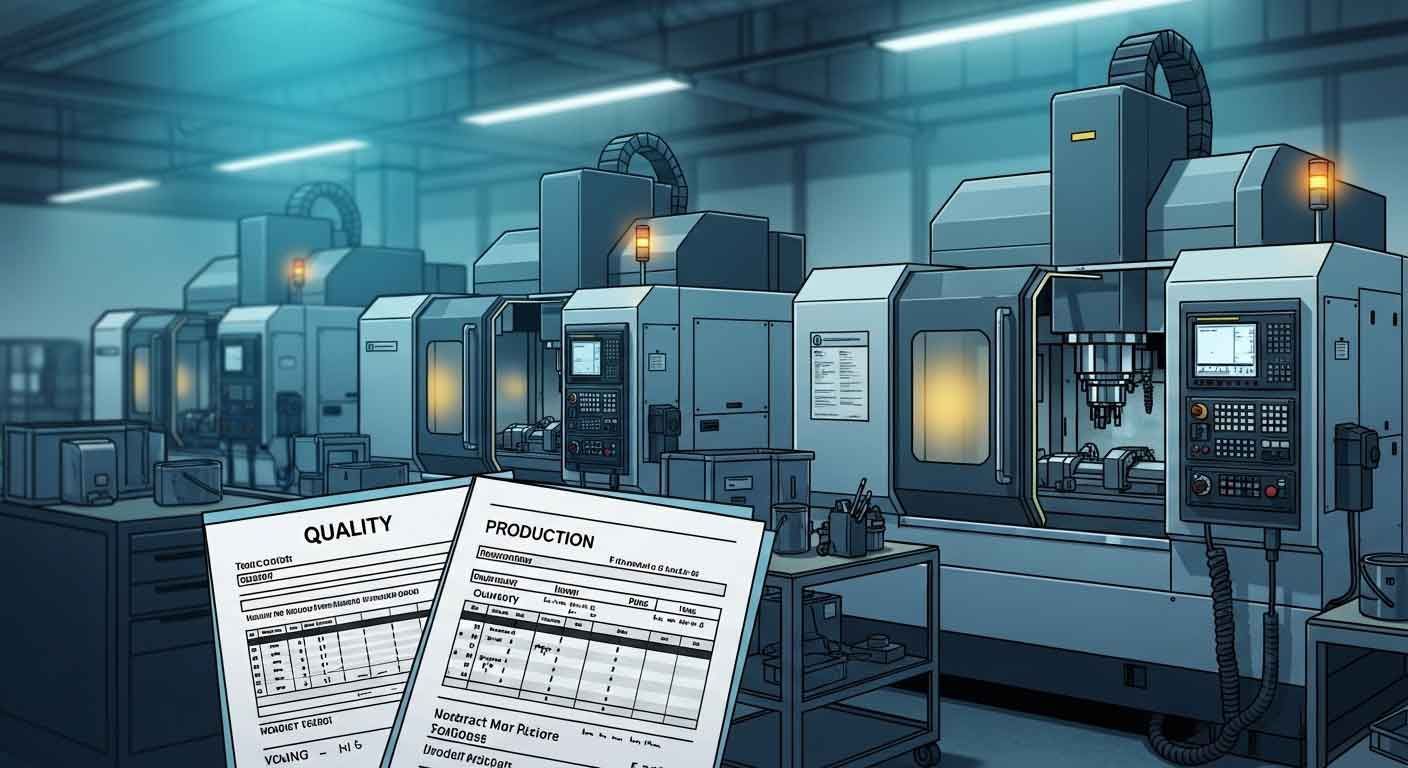
Equipment counts by type matter for the same reason. Not a general statement that the shop runs "a variety of CNC equipment." The actual count. Fifteen 4-axis machining centers. Six 5-axis mills. Three dedicated turning centers. That specificity lets a buyer assess fit before they pick up the phone.
Production line configurations, dedicated vs. flexible cells, and quality checkpoint positions round out the picture. Buyers conducting a supplier review before issuing an RFQ look for this information. When it's absent, the shop that has it wins the shortlist.
Answering the Scalability Question Before Buyers Ask It
Program volumes grow. An OEM awarding a 1,000-unit-per-month contract is often already modeling what happens when that becomes 5,000 units. The manufacturer that can show how their floor scales, whether through additional shifts, equipment availability, or parallel line capacity, removes a major qualification risk.
I notice that most contract manufacturers know the answer to this question. They have run programs at scale. They have expanded shifts to meet demand. But they do not say so. The website describes what the floor does today, not what it can do when a program grows. That omission costs them shortlist positions.
A scalability statement does not need to be complicated. It needs to be specific. Explaining how the operation absorbs volume increases, what lead time commitments look like at different order tiers, and what the ramp process involves gives OEM buyers the information their qualification checklist requires.
How to Structure Production Capability Content
The structure should match how procurement evaluates a supplier, not how the shop wants to tell its story.
- Annual output capacity by process or part type
- Shift structure and available capacity windows
- Equipment count and classification by category
- Typical production run sizes and acceptable MOQs
- Lead times for new programs and repeat orders
- Quality certifications with scope statements, not just badge graphics
- Scalability process and ramp timeline expectations
This is not a capabilities page. It is a qualification reference. A buyer should be able to land on this content, answer the core questions on their shortlist, and move toward an RFQ conversation. Every element that requires a follow-up call before evaluation reduces the probability that they submit one.
Repositioning for Production Contracts
The shift from capability language to capacity language is not a complete website rebuild. It is a content repositioning. The operational information already exists. The shop knows its shift structure, its equipment count, its annual output. What changes is where that information lives and how prominently it appears.
Sometimes manufacturers need external perspective to see what the content is missing. What seems obvious inside the building does not always read as qualification-ready to a buyer evaluating the site from the outside.
How Mansfield Can Help
Mansfield Marketing works with contract manufacturers to restructure website content so production buyers find the qualification information they need to move toward an RFQ. We identify the capacity details, operational specifics, and production data that need prominence and build content architecture around how OEM buyers evaluate suppliers. Contact Mansfield Marketing to discuss repositioning your contract manufacturing website for production buyer qualification by
requesting a quote or calling us at (713) 936-5557.