You Know Your Product, But Can You Sell It?
As a company founder, CEO, or president, you are almost certainly the foremost expert in your field. You know the technology, the process, and the client's problems better than anyone. But through many years of personal experience and hundreds of client consultations, we've seen a recurring pattern: this deep expertise does not automatically make you a great salesperson.
You Are Not Alone: The Reluctant Networker
In fact, the opposite is often true. Many founders prefer to stay out of the spotlight, focusing their energy on servicing clients and innovating the products and services that solve real-world problems, not selling them.
If you cringe at the thought of attending another networking event or trade show, you are not alone. Some people are energized by interacting with strangers and building new relationships. Many are not. If you aren't the type of person who enjoys social networking, your time is likely better spent on the activities that truly energize you and leverage your unique genius.
When scrolling through your LinkedIn feed, it's easy to get the impression that the entire business world thrives on a constant circuit of networking events and trade shows. The endless stream of posts featuring smiling faces and clinking glasses can make you feel like the odd person out if you don't share that enthusiasm. In reality, you are far from alone. Many successful founders and experts secretly—or not so secretly—find these types of social engagements draining rather than energizing. They, like you, would prefer to be building, creating, or solving problems rather than making small talk.
This doesn't mean sales can be ignored. It means you have other strategic paths forward:
- Delegate to team members: Hire and empower a sales team with a true passion for interacting with other people.
- Delegate to a marketing agency: Hire a trusted marketing agency to manage promotion on the digital front. This should work hand-in-glove with your sales team's efforts.
- Attract: Build a sales and marketing strategy based on attraction rather than promotion.
- All of the above: It's not an either/or choice necessarily, and these strategies can be employed concurrently.
Promotion vs. Attraction: A Tale of Two Strategies
Understanding the difference between these two approaches is the key to eliminating the stress you might feel about sales.
A Promotion-Based Strategy is the traditional outbound model. It involves actively pushing your message out to find prospects. This includes activities like attending networking events, working the floor at trade shows, making cold calls, and direct email outreach. For the founder who dislikes this, it’s a constant, energy-draining chore.
An Attraction-Based Strategy, by contrast, is an inbound model. It focuses on pulling prospects toward you by demonstrating expertise and providing value upfront. This is where your marketing system does the heavy lifting, establishing you as the authority in your field and inspiring the right people to engage your business first. This approach aligns perfectly with our FADA® Marketing Framework, which turns your expertise into a powerful sales engine.
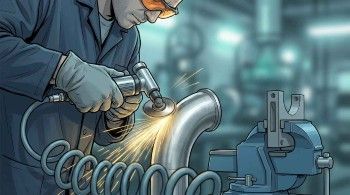
An Industrial Welding Company Example
Let's see how these two strategies play out for a founder of a specialized industrial
welding company.
Promotion Strategy: The founder spends two days a week attending industry luncheons and walking the floors of manufacturing trade shows. They collect business cards, shake hands, and follow up with calls, trying to convince plant managers why their welding technique is superior. It’s effective for some, but for this founder, it’s exhausting and feels unnatural.
Attraction Strategy: Instead of networking, the founder dedicates that same time to collaborating with our marketing team. They leverage their expertise to create high-value content that does the selling for them. This content is published on their website and shared across vital platforms like LinkedIn to attract and engage new prospects.
Here’s what that content looks like in practice:
- Technical Case Studies: A detailed, downloadable report titled, "How We Reduced Component Failure by 45% for a Major Petrochemical Plant Using Advanced Hardfacing Techniques." This is gated content that generates high-quality sales leads.
- High-Impact Video Demonstrations: A professionally filmed short video showcasing their proprietary automated welding process, highlighting the precision and consistency that human hands can't replicate.
- Informative White Papers: An in-depth guide on "Selecting the Optimal Corrosion-Resistant Alloy for High-Stress Marine Applications" positions them as a leading industry authority.
- Valuable Blog Articles: A search-optimized article answering a common client question, such as, "5 Telltale Signs of Weld Fatigue in Pressure Vessels," attracts prospects who are actively looking for solutions.
- Helpful Infographics: A clear, visual comparison of the tensile strength and wear resistance of different welding methods, perfect for sharing on social media to capture attention.
This expertise is then amplified on their
LinkedIn Company Page and the pages of team members with LinkedIn profiles through attraction-based engagement:
- Sharing Project Successes: Posting high-quality photos and videos of a recently completed project (with client permission), detailing the initial challenge, the process, and the successful outcome.
- Publishing Technical Insights: Repurposing blog content into LinkedIn articles to share expertise directly with a network of engineering and procurement professionals.
- Highlighting Team Expertise: Featuring a post about a lead welder earning a new, advanced certification, which builds trust and demonstrates a commitment to quality.
- Engaging in Industry Groups: The founder participates in relevant LinkedIn groups, offering genuine advice on complex welding challenges—not selling, but building a reputation as a trusted expert.
The Attraction Solution
- Foundation: We build a professional website that clearly showcases their unique value and expertise.
- Awareness: The founder helps create a series of detailed blog posts ("5 Ways to Prevent Weld Cracking in High-Stress Environments") and videos demonstrating their proprietary welding technique. Using
SEO+GEO campaigns, we ensure this content appears in search engines when engineers and project managers are looking for solutions.
- Differentiation: We develop an in-depth white paper that serves as gated content, capturing contact information from highly qualified prospects. This content—born from the founder's expertise—clearly distinguishes their company from competitors.
- Action: Now, instead of chasing cold leads, the company receives inquiries from prospects who have already read their content, watched their videos, and are convinced of their expertise. The marketing system has done the initial "selling," allowing the founder or their team to step into a warm conversation focused on solving a specific problem.
Focus on Your Strengths
The stress created by feeling you must engage in sales networking is not necessary. The solution is to lay the groundwork for a system that fits you. You can either delegate the sales process to people with a passion for it or adopt an attraction-based sales strategy that leverages your expertise without forcing you into uncomfortable situations.
By building a system that attracts, you are free to do what you do best: innovating, leading your team, and delivering exceptional results for your clients.