AI Search Results Optimization: How SEO, AEO, and GEO Work to Achieve this Goal

By Doug Mansfield November 3, 2025

AI Search Results Optimization: How SEO, AEO, and GEO Work to Achieve this Goal

Home > Articles > AI Search Results Optimization: How SEO, AEO, and GEO Work to Achieve this Goal

The Evolution from SEO to AI Search


As a B2B business owner, you’ve probably spent years figuring out how to get found on Google. Just when you had a handle on Search Engine Optimization (SEO), the entire landscape changed. Now, we're in a new era of AI-powered search, and it’s introducing a whole new set of acronyms, like AEO and GEO.


Why Early Adopters Will Win the Market

The current AI search landscape represents a pivotal moment, much like the early days of traditional SEO. Early adopters who invest now in a comprehensive AI search strategy will establish foundational authority and secure a significant, defensible advantage. Those who wait until the scales tilt and AI search becomes the predominant path to discovery will find themselves struggling in a far more competitive and saturated market, fighting for visibility that their proactive competitors have already claimed. By acting decisively, you position your brand to be the trusted, go-to source, capturing the sales and revenue that will increasingly flow through these AI-driven channels.


I’ve had hundreds of consultations with business owners, and I know this can be frustrating. It’s simple to make marketing complicated, but it’s very difficult to make it simple.


So, let’s do that. In simple terms, the ultimate goal of our services is to make your business visible to potential new customers who are searching for your solutions in unpredictable ways.


The Three Paths a Modern Customer Takes

Years ago, the path was simple. A customer went to a search engine, typed in a phrase, and clicked on one of the "organic search results," the classic list of blue links on the search engine results page (SERP).


Today, your potential customer might take one of three primary paths. For our example, we'll primarily use Google, but it's critical to remember that the Bing search engine commands a sizeable portion of search traffic and cannot be ignored.


  1. The Organic Path: This is the traditional route. Your customer searches and chooses to click a direct link to your website from the list of organic results.
  2. The AI-SERP Path: Your customer searches, but instead of scrolling down, they engage with Google's AI-powered search results (often called AI Overviews) that appear at the very top of the page. If your business isn't mentioned or cited in this AI answer, you may lose the chance of ever being discovered by this person.
  3. The Direct LLM Path: Your customer bypasses search engines entirely. They go directly to a Large Language Model (LLM) like ChatGPT, Google Gemini, or Perplexity to do their research, ask questions, and discover companies that can solve their problems.


Our job is to ensure you are prominently positioned to be found, no matter which of these three paths your prospect chooses.


SEO: The Minimum Price of Entry

To be discovered, the minimum price of entry is having a website that is already well-optimized for search engines (SEO). This means your website is discoverable by search engine and AI web crawlers, and its content is well-structured.


In many cases, a website with strong SEO might already be appearing in AI search results without you having taken extra steps, simply because Google's AI identifies it as a quality source.


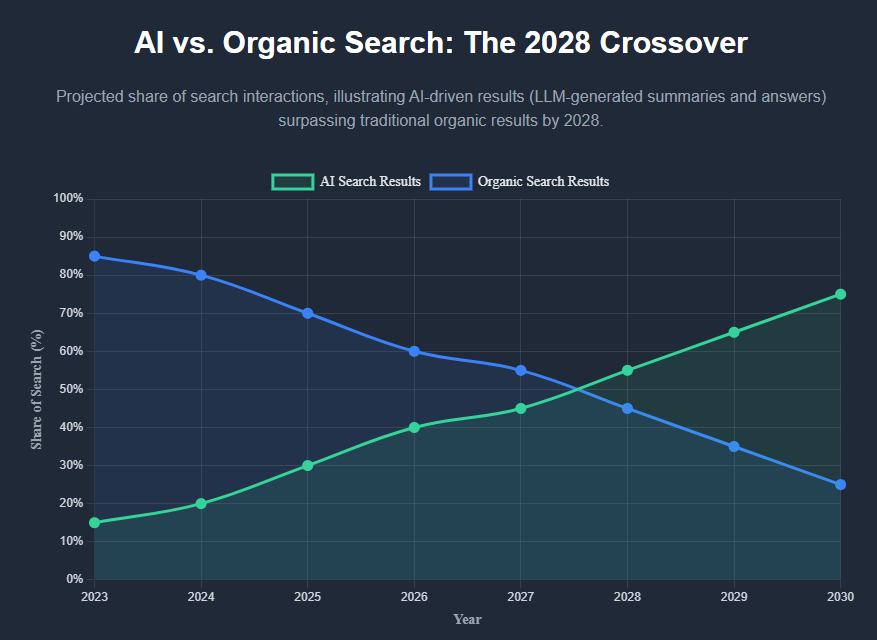
But this landscape is becoming intensely competitive. It is projected that AI search results will soon surpass organic search results in user preference. If you are serious about staking a claim to favorable positions in these AI results, basic SEO is no longer enough. Additional, specific steps are needed.


This is where
AEO and GEO come in.


The Integrated Solution: How SEO, AEO, and GEO Work Together

These three practices are not separate strategies; they are a single, concurrent process designed to position your website for success in this new, complex "discovery phase" of the buying journey.


  • What is SEO (Search Engine Optimization)? This is the  Foundation. SEO is the practice of making your website technically sound, fast, and full of high-quality, relevant content that provides the backbone for your entire strategy. It ensures that search engines can find, crawl, and understand what your business is about.
  • What is AEO (Answer Engine Optimization)? This is the practice of structuring your content to be the single best answer to a specific question. AEO is specifically designed to get your content featured in "zero-click" scenarios like Google's AI Overviews, featured snippets, and voice search replies. It involves creating concise, clear, and "answer-first" content.
  • What is GEO (Generative Engine Optimization)? This is the practice of positioning your brand as a trusted, authoritative source that an AI model can use to create a new, synthesized response. The goal of GEO is not just to be the single answer (that's AEO), but to be cited and referenced within a more complex, conversational summary, like those from ChatGPT or in-depth Google answers.


A good way to think about it is that AEO is the foundation for GEO. You first prove to the AI that you can answer specific questions (AEO), and over time, the AI learns to trust your brand as an authority on the topic as a whole (GEO).


These practices are critical for
B2B marketing. Your prospects are using these AI tools to do their initial research. If we miss the chance of being discovered in this discovery phase, your chance of being shortlisted as a reputable solution they will contact to inquire about products or services becomes slim to none.


The correct solution is to accomplish SEO, AEO, and GEO concurrently. This integrated strategy is the only way to future-proof your 
B2B marketing efforts and ensure you are found, trusted, and chosen by your next customer.


(Chart data source: https://www.semrush.com/blog/ai-search-seo-traffic-study)

Doug Mansfield, President of Mansfield Marketing

Latest Posts

By Doug Mansfield August 13, 2026
H1 Title: Getting Your 3PL Cited by the Procurement Tools Buyers Now Use Content Summary: Write this AI-procurement post for the Logistics & Supply Chain cluster. The target search term is "logistics company marketing." Open with the shift: procurement teams increasingly screen logistics and supply-chain providers through AI-assisted research before a human ever calls, so the 3PL that is legible to those tools reaches the shortlist. Explain what a 3PL or supply-chain consultancy should publish, service-area and modal coverage, verticals served, and compliance credentials, as extractable content engines can cite. Include a short readiness checklist. Write in first-person "I" voice throughout. National. Do not invent figures, percentages, dates, clients, or consultation stories, and do not use em dashes; use only statistics cited to a named public source or numbers Doug provides. Internal links, placed in the first and second H2 sections and sourced only from Content/internal_linking.xlsx: the /logistics-supply-chain hub as the fixed anchor, paired with /logistics and /supply-chain-consulting, plus /ai-search-optimization as the relevant service page. Follow the full Content/blog.md workflow, structure, and pre-publish checklist, including the "How Mansfield Can Help" closing with the /get-a-quote CTA and phone number (713) 936-5557.
By Doug Mansfield August 11, 2026
H1 Title: How Weld and Vessel Shops Turn ASME and AWS Codes Into Search Signals Content Summary: Write this certification-as-signal post for the Manufacturing cluster. The target search term is "pressure vessel and welding fabrication marketing." Open with a liftable point: code stamps and certifications that shops treat as fine print, ASME, AWS, and similar, are exactly the entity signals that qualify them for buyer and AI shortlists when published as structured, searchable content. Explain how a welding or pressure-vessel shop should present its codes, accreditations, and inspection capability so both procurement teams and engines can find and trust them. Include a short list of the certifications buyers filter on. Write in first-person "I" voice throughout. National. Do not invent figures, percentages, dates, clients, or consultation stories, and do not use em dashes; use only statistics cited to a named public source or numbers Doug provides. Internal links, placed in the first and second H2 sections and sourced only from Content/internal_linking.xlsx: the /manufacturing hub as the fixed anchor, paired with /welding-fabrication and /pressure-vessel-tank, plus /schema as the relevant service page. Follow the full Content/blog.md workflow, structure, and pre-publish checklist, including the "How Mansfield Can Help" closing with the /get-a-quote CTA and phone number (713) 936-5557.
Six-axis robotic palletizing cell stacking filled cases inside a beverage bottling plant
By Doug Mansfield August 6, 2026
Plant and controls engineers screen integrators for evidence, not marketing language. What to publish on platforms, protocols, commissioning, and certifications.
NDT technician performing wet fluorescent magnetic particle testing on a forged steel crankshaft
By Doug Mansfield August 4, 2026
The highest-value position for a testing or NDT lab is being named inside a customer's quality requirement, not competing per job. Here is how a lab earns it.
Safety officer inspecting fall protection anchor points on an elevated steel platform
By Doug Mansfield July 30, 2026
EHS directors will not take a first meeting until the engagement pays for itself. Here is the incident cost, compliance, and outcome proof that earns the call.
Middle-aged woman at a desk in a machine shop viewing a parts list catalog on her computer screen
By Doug Mansfield July 28, 2026
Capability data trapped in PDFs and spec-sheet images gets indexed but rarely cited. Publish tolerances, materials, and ratings as on-page text with schema instead.
Construction superintendent surveying finished structural work with the building owner on-site
By Doug Mansfield July 23, 2026
Strong site visits go silent without a follow-up system. Here is the proposal support content and cadence that keeps construction and HVAC firms on the shortlist.
Field service technician performing on-site repair on a hydraulic excavator engine bay
By Doug Mansfield July 21, 2026
Heavy equipment buyers choose dealers on uptime, service response, and downtime cost, not fleet size. Here is how dealers should reposition their marketing.
Structural engineer reviewing a steel connection detail on an active building frame site
By Doug Mansfield July 16, 2026
Engineering firms sit on NDA-protected work that never reaches the website. Here's how to build a portfolio that proves capability anyway.
Service technician inspecting wellhead equipment at a quiet oilfield equipment yard
By Doug Mansfield July 14, 2026
Operators freezing capex doesn't mean oilfield equipment suppliers should stop marketing. The ones who stay visible keep their shortlist spot when spending returns.
A machine shop owner looking thoughtfully through a large window at his production floor below
By Doug Mansfield July 9, 2026
AI engines shortlist manufacturers from consistent entity signals, extractable capability data, and third-party proof. Here is how to get your shop cited.
Ironworker crew bolting a structural steel beam while a crawler crane hoists the next member
By Doug Mansfield July 7, 2026
Industrial buyers now build shortlists inside AI answer engines. The right marketing agency makes your company quotable and cited, not just visible.